简体中文
简体中文 ENGLISH
Tonnage Defines Status: Building a New Qingdao Port
Time:2025-07-13
 Tonnage Defines Status: Building a New Qingdao Port
While pressing ahead with forward-looking infrastructure development, Qingdao Port is accelerating its transformation from a logistics port into a hub port, trade port, financial port and digital smart port, further sharpening the competitiveness of Qingdao as an international shipping center.
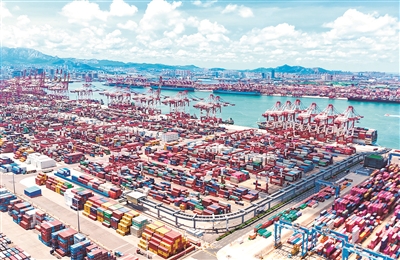
At Qianwan Container Terminal of Shandong Port Qingdao Port, dozens of cargo ships are busy loading and unloading goods.
By Zhou Xiaofeng, Reporter of Qingdao Daily / Guanhai News
At Dongjiakou Port Area of Shandong Port Qingdao Port, towering approach bridges, newly painted ship unloaders and spectacular storage tanks fully demonstrate the charm of the port’s mega projects.
Since the start of this year, Qingdao Port has expedited the implementation of major projects, vigorously extended and expanded the port’s industrial and supply chains, and forged ahead to build a world-class marine port. The Shandong Port Shipping Finance Center has been put into operation. The Phase II liquid chemical storage project at Dongjiakou Port Area was officially commissioned, and the second 400,000-ton ore terminal passed final acceptance. Approval has been granted for the shoreline use of multiple key projects, including Berths 7–8 at the North Third Jetty, the general cargo terminal at the bottom of Langya Bay, and the eastern container terminal in the Langya Bay operation area. Supported by these landmark achievements, Qingdao is embarking on a new journey to foster new strengths in port and shipping.
In accordance with the Master Plan of Qingdao Port (2035), Qingdao Port will continue to evolve into a hub, trade, financial and digital smart port, essentially creating a brand-new Qingdao Port and further enhancing the status and competitiveness of Qingdao International Shipping Center.
Forward-looking Infrastructure LayoutThere is a well-known adage in the port and shipping industry: Tonnage defines status. A host of indicators are adopted worldwide to evaluate top-tier ports, yet sound infrastructure remains a core criterion for measuring a port’s operational capacity and the fundamental hardware for developing an international shipping center.
As the largest foreign trade port in northern China and the world’s fifth-largest container port, Qingdao Port boasts superior port conditions, leading the Northeast Asian region. In 2009, Qingdao Port handled its first ten million TEUs (twenty-foot equivalent units) of containers. Its container throughput has maintained robust growth ever since: exceeding 20 million TEUs in 2019 and hitting a new milestone of 30 million TEUs in 2023. Behind each ten-million-TEU leap lies the strong hub capacity underpinned by sustained port project construction.
The Master Plan of Qingdao Port (2035), approved last year, sets the vision of building Qingdao Port into a world-class powerhouse port, a shipping and logistics hub, an engine driving regional economy and a vibrant waterfront space, and calls for the construction of a new Qingdao Port.
To realize this goal, proactive infrastructure planning is indispensable.
This year, Qingdao Port has taken the lead in strengthening its core competitiveness. A batch of key projects including Berths 7–8 at the North Third Jetty of Dongjiakou Port Area have started construction, covering specialized terminal clusters, port supporting facilities, comprehensive logistics distribution systems and integrated development of ports, industries and urban areas, with a total investment of 77 billion yuan. Among them, the container terminal upgrading project on the north bank of Qianwan Port Area will help Qingdao Port sustain its advantages in container throughput.
The second 400,000-ton ore terminal at Dongjiakou Port Area is also of great strategic significance.
A decade ago, the first 400,000-ton ore terminal at Dongjiakou Port Area received its first 400,000-ton vessel, ushering in an era of large-vessel dry bulk cargo operations for China’s ports. Since then, it has consistently ranked first among China’s coastal ports in handling large bulk carriers. The second 400,000-ton ore terminal will soon be put into service. Together with the existing one, the two terminals will form a world-class dual 400,000-ton ore terminal cluster, lifting Qingdao Port’s hub capability to a new level.
Deepening Integrated Development of Port, Industry and CityPorts handle 90% of global trade cargo and serve as a vital link in industrial and supply chains. Taking ports as the pivot to advance the integrated development of port, industry and city has become a core part of building Qingdao International Shipping Center.
As a national distribution hub for bulk cargoes and a key energy storage and transportation base, Qingdao Port is an important trading port for bulk commodities such as natural rubber, cotton, pulp, crude oil, iron ore and grain. Statistically, one ton out of every six tons of crude oil imported into China and one ton out of every nine tons of iron ore enter the country via Qingdao Port. The massive cargo inflow and outflow have created favorable conditions for developing port-side industries including logistics and warehousing, processing and manufacturing, and international trade.
A large number of leading domestic and overseas enterprises have settled in Qingdao to develop port-side industries, attracted by its superior geographical location. They include Japan’s major general trading company Itochu Corporation, Singapore-based commodity trading giant Trafigura, global renowned agricultural product trader and processor Louis Dreyfus Company, and key national agricultural industrialization enterprise Shandong Bohai Industrial Group.
Take the grain and oil processing industry as an example. Efficient and convenient logistics are core competitiveness. Building production facilities near ports brings remarkable economic benefits for grain and oil enterprises. Leveraging the port’s advanced warehousing facilities and logistics network, enterprises can easily receive raw materials from across the globe and deliver finished products to vast inland markets covering Shandong, Henan, Shaanxi and other provinces. In recent years, Qingdao Port, together with the Administrative Committee of Qingdao West Coast New Area, has facilitated the settlement of projects such as Louis Dreyfus Company’s facilities in Dongjiakou Port Area.
On June 26, the Louis Dreyfus Food Technology Industrial Center project located in Dongjiakou Port Area officially broke ground. With a total investment of approximately 1 billion US dollars and a land area of about 333,000 square meters, the project will be implemented in three phases. The first phase focuses on the processing of feed protein raw materials including soybeans, rapeseeds and cottonseeds, as well as high-end feed, food-grade phospholipids and special edible oils. It is designed with an annual soybean crushing capacity of 2 million tons, and is expected to generate an annual output value of 10.8 billion yuan upon full operation. The second and third phases will mainly develop pet food, innovative food and clean energy sectors.
Qingdao Port is also actively promoting the landing of the China State Grain Reserves warehousing project to attract more grain and oil enterprises to set up plants near the port. Invested by China State Grain Reserves (Qingdao) Storage Co., Ltd., the project will be constructed in two phases. The first phase involves a total investment of 765 million yuan and a newly built bulk grain storage capacity of 300,000 tons, and is expected to start construction soon. Upon completion, the project will help enhance the resilience of national and regional grain supply chains, diversify grain varieties and safeguard national food security.
Accelerating the Development of Smart and Green PortFor world-class ports, upgrading means not only expanded infrastructure capacity, but also industrial and operational transformation driven by technological innovation. Currently, Qingdao Port is exploring new development paths, with digitalization, intellectualization and green development as its core priorities.
Recently, Qingdao Port completed the first bunkering operation of biofuel oil for international sailing vessels among ports in northern China, and welcomed Hydrogen-Electric Tug 1, China’s first hydrogen-powered tugboat. Earlier, the port obtained the qualification for handling green methanol and signed a Memorandum of Understanding on green energy supply with 10 shipping companies.
Promoting the development of green port and shipping industries and upgrading port service capacity are not only requirements for port transformation and upgrading, but also new goals for building Qingdao International Shipping Center. The green transition of the shipping industry is an irreversible trend, driving growing demand for bunkering of green energy such as LNG, methanol, ammonia and biofuels. World-class ports are competing to build green energy bunkering hubs. Shanghai Port is the first port in China capable of ship-to-ship green methanol bunkering, while the Port of Rotterdam hosts the world’s densest fleet of LNG bunkering vessels.
According to officials, Qingdao Port is pushing forward green energy bunkering, replacement of traditional energy with clean energy for port equipment, and the application of new energy across the port area. It is expected to realize regular ship-to-ship bunkering of methanol and LNG by the end of this year.
Aiming to build a world-leading smart and green port, Qingdao Port is advancing the digital transformation of the entire logistics chain by applying artificial intelligence and digital technologies, so as to deliver higher-quality services for upstream and downstream industrial players.
For instance, a pulp shipment departing from the Port of Santos in Brazil, unloaded at Qingdao Port and finally delivered to domestic paper mills can complete vessel declaration and electronic bill of lading issuance with just a few clicks, eliminating the use of paper documents. Relying on the intelligent freight system of the PulpCrane platform, Qingdao Port has realized full-process digital operation of the pulp logistics network.
Digital supply chain services for pulp are just one part of Qingdao Port’s efforts to foster new productive forces in the port sector. In recent years, Qingdao Port has made remarkable achievements in building a smart and green port: it launched Ark TaaS, China’s first large-scale AI model for port services, and Yuheng, the first cloud-edge collaborative intelligent platform in the port industry. The country’s first fully domestically developed automated container terminal has achieved high operational efficiency right after commissioning, and a new-generation intelligent container management system has been put into use.
These transformations are reshaping the industrial landscape and future development of the city, unlocking enormous potential for the port and shipping economy.