简体中文
简体中文 ENGLISH
Growing Influence of the Port
Time:2019-06-21
Growing Influence of the Port
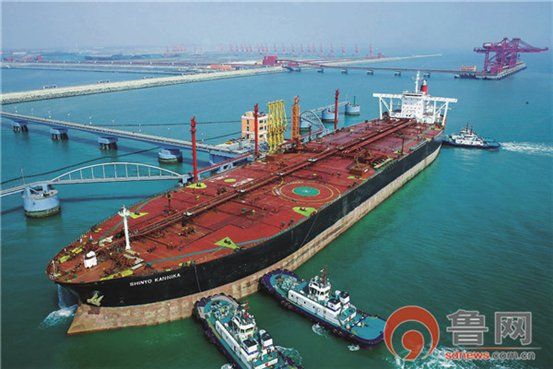
As a renowned deep-water major port in China, Dongjiakou Port Area has built 26 berths, among which 18 are operational. It is home to the world’s largest 400,000-ton ore terminal, the largest supporting storage yard nationwide, a crude oil terminal capable of berthing 450,000-ton oil tankers, Sinopec’s first LNG receiving station in China, and the terminal with the largest bulk grain handling capacity along the Yellow River Basin. Construction of a second 300,000-ton crude oil terminal is already underway.
The port has built a total of 4 million square meters of storage yards for ore and general cargo with a storage capacity of 55 million tons. It also features oil tank farms with a total volume of 2.86 million cubic meters, natural gas tank farms of 640,000 cubic meters, and grain silos with a storage capacity of 260,000 tons.
On July 4, 2015, the 400,000-ton bulk carrier Yuanzhuohai successfully berthed at Dongjiakou Port, making it the first terminal in China capable of direct berthing for 400,000-ton bulk carriers and ushering in an era of large-vessel dry bulk cargo operations for China’s ports. On July 18, 2016, the State Council officially approved the opening of Dongjiakou Port as a first-class port.
On March 15, 2018, Qingdao Shihua Company was awarded the qualification as one of China’s first designated delivery warehouses for crude oil futures, meaning Dongjiakou Port was officially eligible to conduct crude oil futures delivery business. In the first half of 2018, foreign trade container routes were launched here. Equipped with the national qualification for crude oil futures delivery, the port gained new momentum to build a world-class marine port and took solid steps in implementing national strategies.
With the opening of the Qingdao-Yancheng Railway and port feeder railways, the port area has formed an all-round land, sea and air transportation network, which will drive its rapid development.
Accelerated, High-quality and Efficient Project Development
Riding on the development momentum of the West Coast New Area, Dongjiakou Economic Zone has attracted more than 70 projects each with an investment of over 100 million yuan, with a total investment exceeding 160 billion yuan. The portfolio includes 6 mega-projects with investment above 10 billion yuan and 13 projects invested by Fortune Global 500 and China Top 500 enterprises. By the end of 2018, 36 projects had been put into operation, involving a total investment of 70 billion yuan.
The Jineng Technology Project, with a total investment of 20.3 billion yuan, achieved signing and commencement within the same year, setting a new record for project introduction and construction. The Northern China Aquatic Products Trading Center and Cold Chain Logistics Base Project, with an investment of 10.2 billion yuan, advanced steadily. Adjustments to marine functional zoning and navigation-restricted areas were fully completed, the tendering for the breakwater project was finished, and the main structure of the first phase of the 150,000-ton cold storage was completed.
The Dongjiakou Railway Logistics Park was put into operation, opening up a multi-modal logistics channel for containers, general cargo and bulk cargo at the port. Gulf Chemical ranks among the top three in China with an annual polyvinyl chloride production capacity of 300,000 tons, and its products have entered high-end global markets.
The Double Star Industry 4.0 project stands as a model for the transformation of old growth drivers into new ones and is hailed as a pioneer in intelligent tire manufacturing across China. Following a strategic restructuring with CITIC Group, Qingte Steel has increased its special steel output to over 60% of its total production. Its newly developed high-end bridge stay cables have broken international technological monopolies, making the company the sole domestic supplier able to replace imported stay cable products.
The qualification application for Dongjiakou Chemical Park was a tight and arduous task. The economic zone immediately set up a leading group and special working teams. It commissioned top-tier institutions including the China National Petroleum and Chemical Planning Institute to compile five plans such as the Overall Development Plan for Qingdao Dongjiakou Economic Zone Chemical Park. With support from 13 provincial government departments, the park obtained official approval from the Shandong Provincial Government on September 28, 2018. It became the first chemical park in Shandong boasting superior deep-water port advantages, paving the way for the clustered development of high-end and eco-friendly chemical projects.
Building a New Brand for Circular Economy and Streamlined Government Services
Targeting the establishment of a national circular economy demonstration zone, Dongjiakou Economic Zone has formulated more than 20 indicators for resource consumption and ecological environmental protection in line with international standards. All settled projects must meet quantitative requirements concerning industrial policies, park planning, market access standards, intensive land use, water conservation and waste discharge.
Four major circular systems have been initially established covering internal enterprise operations, inter-industry cooperation, regional coordination and public utility sharing, driving the formation of industrial chains featuring circular economy. The water recycling rate exceeds 80%. The zone saves 2 billion kWh of electricity and recycles 700,000 tons of steam annually. Resources are fully utilized from raw materials and finished products to by-products, waste gas, wastewater and solid waste, exploring a viable path for building a national-level circular economy demonstration zone.
The economic zone has advanced the reform of One-Stop Service, adopting an all-inclusive and full-process service model and a one-window approval system to create a first-class business environment. It optimized the approval procedures for 28 administrative licensing items and incorporated 25 non-administrative approval items into the service process, with dedicated service flow charts for project approval.
Comprehensive services including undertaking, agency assistance, coordination and supervision have been rolled out. Mechanisms such as acceptance with incomplete documents, parallel examination and approval, and on-demand consultation have been improved, alongside online service channels to streamline and accelerate project approval.
As a pioneer in piloting regional assessment in Qingdao, the zone completed expert reviews on regional seismic safety assessment and soil and water conservation reports for the cold chain logistics park, greatly boosting project progress efficiency.
Rapid Improvement of Park Supporting Capabilities
To date, the infrastructure of Dongjiakou Economic Zone has reached the standard of Nine Utilities and Leveled Land. A series of infrastructure projects covering water supply, gas supply, power supply, roads and greening have been completed, forming a transportation network featuring three vertical and three horizontal arteries to fully support settled enterprises and projects.
Water Supply: The daily water supply capacity reaches 260,000 tons, including 100,000 tons from seawater desalination. The daily sewage treatment capacity stands at 38,000 tons.
Power Supply: Two 220kV substations and eight 110kV substations have been built. Construction of power line corridors for the Hujiashan Substation is underway, and the 10kV power line for Luhaifeng has been completed.
Road Transportation: The over-rail sections of two overpasses have finished main construction and are scheduled to open to traffic in July 2019. Progress is steady on the Donglai and Dongliang expressways, and efforts are made to start construction on the connecting section between the Dongliang Expressway port branch and the Shenhai Expressway within the year. Twelve roads including Gangchang Road and Gongbei Road are under rapid construction. The crude oil pipeline linking Dongjiakou, Weifang, Central Shandong and Northern Shandong has been put into operation, further improving the integrated transportation system combining sea, railway and highway transport.
Gas and Heat Supply: The Huaneng heating boiler project has been launched in the initial stage, with 34 kilometers of high-temperature hot water pipelines and 8 kilometers of steam pipelines built, delivering steam at 150 tons per hour to meet current heating demands. Construction of the Huaneng 2×350MW cogeneration power plant and its supporting heat supply network has commenced.
Utility Corridors: A public chemical pipeline corridor with a total length of 11.4 kilometers was built at a cost of 1.8 billion yuan, serving as a vital channel for the transportation of liquid petrochemical products between the port and settled enterprises.